What Are ESD Garments Made Of?

If you work in electronics manufacturing, semiconductor production, or other static-sensitive environments, you have probably seen ESD garments such as lab coats, jackets, pants, polo shirts, and coveralls.
But what are ESD garments made of?
Unlike ordinary workwear, an ESD garment is designed with conductive materials that help control electrostatic charge. The fabric, conductive yarn, garment design, and manufacturing process all affect how well the clothing performs.
At JSJM, ESD clothing is mainly made from polyester-based fabrics combined with conductive fibers. Different fabric structures and material blends are available for different working environments.
What Material Is Used in ESD Garments?
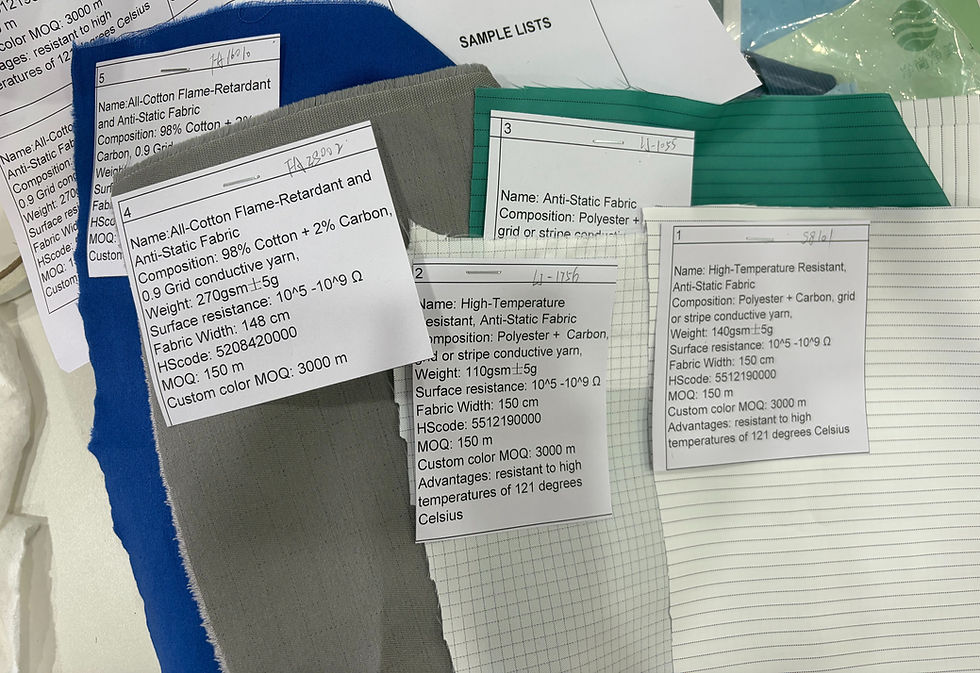
The most common material used in JSJM ESD apparel is polyester filament combined with conductive fiber, including conductive carbon fiber yarn.
A typical ESD fabric can contain 98–99% polyester filament and 1–2% carbon yarn. The conductive yarn is integrated into the fabric rather than simply applied as a surface coating. This creates conductive paths that help dissipate static electricity.
Polyester is widely used because it offers several useful properties for ESD workwear. It is durable, relatively lightweight, easy to maintain, and suitable for controlled environments where low particle generation is important.
The conductive fiber is the key part that gives the fabric its static-control function.
This combination is commonly used to manufacture different types of ESD protective clothing, including ESD lab coats, jackets, pants, shirts, and cleanroom coveralls.
Why Is Conductive Fiber Added to the Fabric?
Static electricity can build up when people move, walk, sit, or handle materials. In an ESD-controlled workplace, uncontrolled static discharge can potentially damage sensitive electronic components.
Conductive fibers provide a path for static charge to dissipate in a controlled way.
This is why an ESD garment is different from ordinary polyester clothing. Simply wearing polyester does not automatically make a garment suitable for ESD protection. The fabric needs an appropriate conductive structure and must meet the required electrical performance.
For example, JSJM's ESD polo shirt uses polyester fabric with permanently integrated conductive fibers. Its surface resistance is specified at 10⁶–10⁹ Ω, depending on the product specification.
Stripe ESD Fabric vs. Grid ESD Fabric
Another important factor is how the conductive yarn is arranged in the fabric.
ESD fabrics are commonly produced in stripe or grid structures.
Stripe fabric places conductive yarns in parallel lines. It is a practical option for many general ESD workwear applications.
Grid fabric uses conductive yarns arranged in a grid pattern. This creates a more distributed conductive network across the fabric and is commonly used for garments where more comprehensive static control and contamination control are required.
JSJM supplies polyester ESD fabrics with different conductive structures, including 5mm stripe, 5mm grid, and 2.5mm grid patterns.
The right structure depends on the application, cleanroom requirements, garment design, and required ESD performance. It is better to select the fabric based on the working environment rather than simply choosing the lowest-cost option.

Are ESD Garments Always Made of 100% Polyester?
No.
Although polyester with conductive fiber is widely used, ESD clothing can also be made from polyester/cotton blends with conductive threads.
For example, JSJM offers an ESD cleanroom coverall made from 65% polyester / 35% cotton with conductive fiber. This type of fabric can provide a different balance between static control, durability, and wearing comfort.
The choice of fabric should therefore depend on where the garment will be used.
For cleanroom applications, polyester-based conductive fabrics are often selected because cleanliness and particle control are important. For some industrial environments, a polyester/cotton conductive fabric may be preferred for its wearing characteristics.
What Types of ESD Clothes Are Available?
ESD clothing is not limited to one particular style.
Depending on the workplace, companies may use:
ESD lab coats for laboratories, inspection areas, and electronics workstations
ESD coats and smocks for daily industrial work
ESD jackets and ESD pants for two-piece workwear
ESD polo shirts and ESD shirts for factory and production environments
ESD coveralls for applications requiring more complete body coverage
ESD cleanroom garments for environments where both static and particle control are important
For example, JSJM's ESD lab coat uses 98% polyester and 2% conductive fiber in a grid structure.
For cleanroom applications, JSJM also offers hooded ESD coveralls made with polyester and conductive threads. These garments are designed to combine electrostatic control with contamination control.
What Is ESD Protective Clothing Used For?
The choice of ESD clothing depends heavily on the industry.
In electronics manufacturing and semiconductor production, ESD garments help control static charge around sensitive components, PCB assemblies, and precision equipment.
In cleanrooms, the garment may need to provide both ESD protection and contamination control. In these situations, fabric construction, particle release, garment design, and cleanroom classification all need to be considered.
JSJM supplies ESD apparel for applications including electronics manufacturing, semiconductor production, pharmaceutical manufacturing, medical device production, biotechnology, automotive electronics, and other controlled environments.
How Can You Check ESD Garment Performance?
Choosing the right material is only the first step. The finished garment should also be tested.
An ESD garment tester or surface resistance testing equipment can be used to check the electrical resistance of the fabric or garment. The actual testing method and acceptance range should follow the requirements of the customer's ESD control program and applicable standards.
For example, different JSJM ESD products specify surface resistance ranges such as 10⁶–10⁹ Ω. Product specifications and test data should be reviewed before bulk purchasing, especially when the garments are being used in an audited ESD-controlled environment.
A reliable supplier should be able to provide product specifications and relevant test information rather than simply describing a garment as “anti-static.”

How to Choose the Right ESD Clothing
When selecting ESD clothing, consider these points:
1. Fabric compositionCheck whether the garment uses polyester, polyester/cotton, conductive carbon fiber, or another conductive material.
2. Conductive structureAsk whether the fabric uses a stripe or grid structure and whether it matches your application.
3. Surface resistanceConfirm the specified resistance range and request test information when necessary.
4. Cleanroom requirementsIf the garment will be used in a cleanroom, consider particle generation, fabric construction, garment design, and cleanroom classification.
5. Garment styleChoose an ESD lab coat, anti-static smock, ESD jacket, ESD pants, ESD polo shirt, or full ESD coverall according to the level of coverage required.
Final Thoughts
So, what are ESD garments made of?
In many cases, the main fabric is polyester combined with conductive carbon fiber or other conductive fibers. However, the exact composition, conductive pattern, fabric weight, and garment design can vary according to the application.
For buyers, the most important point is not simply the name of the material. The complete garment should provide stable ESD performance and be suitable for the working environment.
JSJM supplies ESD clothing, conductive fabrics, cleanroom garments, and customized ESD workwear for global industrial customers. With different fabric structures, garment styles, and OEM options, buyers can select a solution based on their specific ESD and cleanroom requirements.