How to Choose the Right ESD Lab Jacket: A Practical Buying Guide

An ESD lab jacket is a common choice for workplaces where static electricity needs to be controlled. It is widely used in electronics manufacturing, semiconductor production, laboratories, and other ESD-protected areas. However, choosing the right jacket involves more than selecting a color or size. Fabric, garment length, collar style, cuffs, pockets, and grounding requirements all matter.
If you are buying ESD lab coats or smocks for your team, this guide will help you compare the available options and find a style that suits your workplace.
1. How Does an ESD Lab Jacket Work?
Static electricity can build up on a person's clothing through movement and contact with other materials. When the charge is released suddenly, it may damage sensitive electronic components.
An ESD lab jacket is made with conductive fibers or yarns, often containing carbon fiber, woven into the fabric. These fibers help control electrostatic charge and reduce the electrostatic field generated by ordinary clothing underneath.
However, an ESD jacket is only one part of a complete static-control program. Its performance depends on the fabric, garment construction, and how it is used with other ESD control measures.
What about a grounding plug or cord?
Some specialized ESD garments are designed with a grounding connection, such as a snap fastener for attaching a grounding cord. When the garment is connected to a suitable grounding system, the connection can provide a path for charge dissipation.
Not every ESD lab jacket needs a separate grounding cord. Many conventional ESD garments are used as part of a personnel grounding system that includes appropriate ESD footwear, flooring, or wrist straps. The correct setup depends on your workplace requirements.
Before ordering a jacket with a grounding connection, confirm the design, connection method, and required electrical performance with your supplier.
2. Choose the Right Fabric for Your Workplace
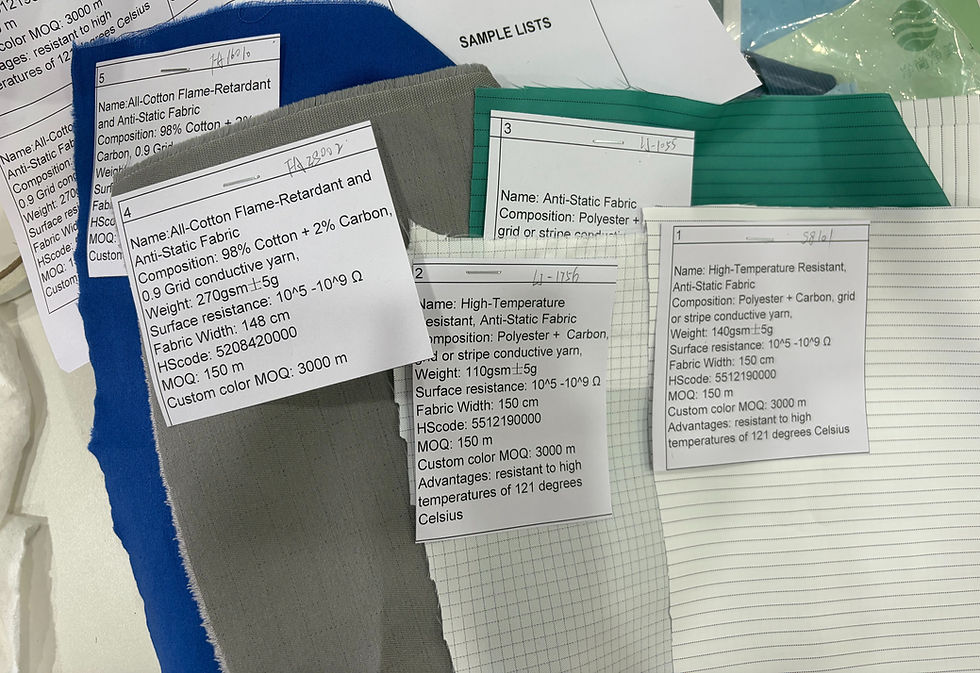
Fabric is one of the most important factors when selecting an ESD lab jacket. Two common options are polyester with conductive carbon fiber and polyester-cotton with conductive threads.
Polyester + Carbon Fiber
Polyester-based ESD fabric is widely used in electronics and controlled environments. Conductive carbon fibers are integrated into the fabric to help control static electricity.
This material is worth considering for semiconductor production, electronics assembly, and workplaces where low particle generation is important. The fabric weight and stripe or grid construction can also be selected according to the application.
Polyester-Cotton + Conductive Threads
Polyester-cotton fabric combines polyester with cotton and conductive threads. It may be suitable for workplaces where wearing comfort and everyday industrial use are important.
If you are comparing ESD garments with ordinary cotton lab coats, remember that standard cotton lab coats are not automatically ESD protective. The material composition and electrical performance must meet your requirements.
Similarly, a flame resistant lab coat is designed for a different protective purpose. If your workplace requires both flame resistance and static control, ask for a suitable fabric solution and supporting test information rather than assuming that an ordinary ESD jacket provides flame protection.

3. Select the Right Jacket Length and Sleeve Style
The jacket length affects coverage, movement, and comfort. Consider how employees work throughout the day before choosing a design.
Waist-length: A shorter option for workers who need greater freedom of movement and less coverage.
Three-quarter thigh-length: A practical middle option that provides additional coverage without extending to the knees.
Knee-length: Offers more coverage over the clothing underneath and is a common style for laboratory and production work.
Sleeve length is another consideration.
Long sleeves: Suitable for workplaces that require more arm coverage.
Short sleeves: An option for warmer environments or tasks where greater arm mobility is preferred.
The best choice depends on the work process, dress code, and ESD control requirements. For cleanroom use, also consider whether the jacket provides sufficient particle control for the specified cleanroom class.
4. Collar, Cuffs, and Pockets: What Should You Look For?
Small design details can make a difference when employees wear their jackets for an entire shift.
Collar styles
A lapel collar gives the jacket a traditional laboratory-coat appearance. A mandarin collar, also called a stand collar, provides a more closed neckline. Choose the style that fits your workplace dress code and coverage requirements.
Cuff styles
Elastic cuffs offer a closer fit around the wrist. Knit cuffs are another option, while adjustable cuffs may be useful when workers need to change the opening size.
Consider whether employees need to wear gloves over or under the cuffs. For controlled environments, the complete garment design should also be checked against the required contamination-control procedures.
Pocket options
Common choices include a chest pocket and lower patch pockets. Chest pockets are useful for small work items, while lower pockets provide additional storage.
For cleanroom applications, however, extra pockets may not always be desirable because they can collect particles. Choose pocket placement and quantity according to the work process and cleanliness requirements.

5. Should You Choose Logo Printing or Embroidery?
Adding a company logo helps identify employees and gives your team a consistent appearance. The two common customization options are printing and embroidery.
Logo printing is worth considering for designs with multiple colors, detailed graphics, or a smooth finish. The printing method should be compatible with the garment fabric and workplace requirements.
Logo embroidery creates a stitched design and can work well for company names, simple logos, or employee identification. However, embroidery adds stitching and may not be appropriate for every cleanroom application.
For garments used in highly controlled environments, confirm whether the logo material and application method meet your cleanliness and ESD requirements.
Before production, provide the original logo file and confirm the logo size, position, color, and preferred customization method.
6. Where Are ESD Lab Jackets Commonly Used?
ESD lab jackets and smocks are used in different workplaces where static control is important.
Electronics manufacturing: Helps control electrostatic risks during assembly, inspection, and testing.
Semiconductor production: Forms part of the garment and personnel grounding arrangements used in ESD-controlled areas.
Laboratories: Suitable for selected testing, research, and inspection environments that require static control.
Automotive manufacturing: Can be used in electronics assembly and other production processes involving static-sensitive components.
Cleanrooms: ESD garments may be used where both static control and contamination control are required, provided the garment is suitable for the specified environment.
Depending on the application, employees may also need compatible ESD booties or ESD shoe covers. These products serve different purposes and should be selected according to the workplace's footwear and grounding requirements. For cleanrooms, shoe covers must also be suitable for the required cleanliness level.
7. How to Choose the Right ESD Lab Jacket from a Supplier
Before placing a bulk order, prepare a list of your actual requirements. This makes it easier to compare products and avoid paying for features your team does not need.
Consider the following questions:
What is the working environment: electronics production, semiconductor manufacturing, a laboratory, or a cleanroom?
Do you prefer polyester with carbon fiber or polyester-cotton with conductive threads?
Which length do you need: waist, three-quarter thigh, or knee-length?
Do you prefer long or short sleeves?
Would you like a lapel collar or mandarin collar?
Do you need chest pockets, lower patch pockets, or both?
Which cuff style, color, and size range are required?
Do you need logo printing, embroidery, or a grounding connection?
What ESD performance and other workplace requirements must the garment meet?
At JSJM, we offer customizable ESD lab jackets, ESD lab coats, and smocks for different industrial applications. Sharing your working environment, preferred collar and cuff styles, colors, sizes, and logo requirements helps us recommend a more suitable option.
Looking for customized ESD lab jackets for your team? Contact JSJM with your specifications to discuss fabric choices, garment design, and available customization options.